

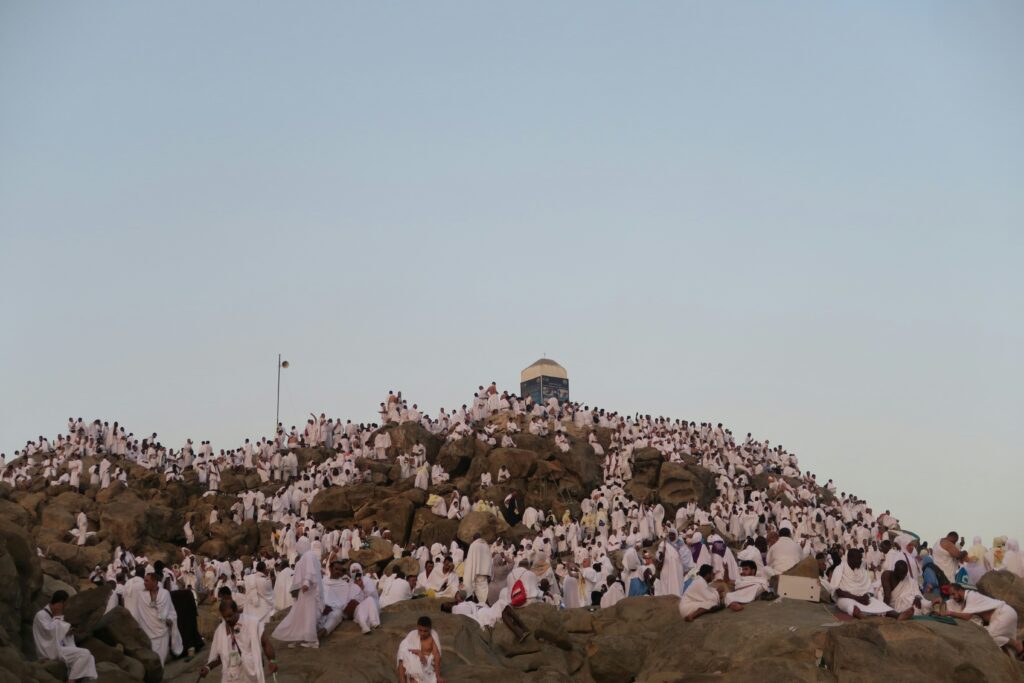
Abbas bin Mirdas (may Allah be well pleased with him) narrates that the Messenger of Allah ﷺ prayed that his nation be forgiven on the evening of the Day of Arafah. Allah responded: “I have forgiven them, save for the one who has wronged someone else, for I will take him to account on behalf of the one he has wronged.”
The Prophet ﷺ said: “O my Lord, if You wish, You could give the person who has been wronged more in Paradise and You could forgive the wrongdoer.” The Prophet received no response that evening.
The next morning in Muzdalifah, he repeated his prayer and it was answered. He was then seen with a large smile on his face.
Abu Bakr and Umar (may Allah be pleased with them both) noticed this and said: “May my father and mother be your ransom, this is a time we would not expect to see you smiling, so why are you smiling? May Allah keep you smiling always.”
“When Iblis, the enemy of God, learned that my prayers had been answered and my nation had been forgiven, he took some dust and scattered it on his head and called out for his own destruction. When I saw his panic, I smiled.”
(Narrated by Ibn Majah No. 3013)
On the Day of Arafah, there is a huge outpouring of God’s mercy and forgiveness. On that day on his Farewell Pilgrimage, the Messenger of Allah ﷺ stood on the Plain of Arafah and spent the afternoon pleading with his Lord to forgive his nation. The greatest of all men was standing on the greatest day of the year, asking his Lord for the greatest of things for the greatest number of people, in the knowledge that Allah’s mercy knows no bounds.
When most of us pray, we know that God hears our prayers and we wait for them to be answered. But when the Prophet prayed, he often received a direct response from God. The Prophet has such a high status with his Lord that even when his requests have been granted, he can keep asking for more. This is no surprise when Allah says: “Your Lord is sure to give you so much that you will be well satisfied” (93:5). He is the one who intercedes on behalf of his nation and his intercession is accepted. He is, of course, still the servant and Allah is the Lord, and he always maintains correct etiquette, but he can address Allah in a way that no one else can. He speaks to Allah with a familiarity that only the Beloved of Allah can do.
Allah may overlook the rights He has over His servants, but He cannot easily overlook the right of a person who has been wronged. But the Prophet suggests another way. Allah can redress the imbalance: He can give the wronged person gifts in the next life that will cause anything that he is owed to pale into insignificance.
The Prophet ﷺ did not receive an answer to his prayers that night. He pleaded with Allah again the following morning after spending the night at Muzdalifah. It was then that he was told that his prayers had been answered and his face lit up with joy. His close companions were so attuned to the Prophet’s states that they immediately wanted to know why he was happy and he duly explained. He had so much concern for the members of his Ummah that he wanted every door of mercy and forgiveness to be open to them. Nothing made him happier than more doors being opened. The Devil is the opposite: he wants people to turn away from Allah, to be denied His forgiveness and ultimately to despair. The more Allah forgives people, the more the Devil is angered and frustrated. The Prophet smiled or even chuckled at the Devil’s antics. We ask Allah to keep the Prophet smiling as he witnesses the Devil’s efforts coming to nothing and the mercy of Allah continuously flowing.
Note
The scholars discuss the meaning and implications of this hadith (and other similar narrations) and who Allah’s forgiveness is for. Some held that it only applied to those who performed hajj with the Prophet ﷺ that year. Others say it applies generally to anyone who performs hajj but only in specific situations. An example would be if someone performs hajj and then dies before being able to right any wrongs that he had done to others, then Allah may forgive him. Or it could be that someone will be forgiven for wrongs that he has done to others that he is unaware of. What is certain is that no one has a free licence to wrong others and then think that performing hajj will be an atonement for that. We still must give Allah what is due to him (such as making up missed prayers) and give to people what is due to them (such as money owed and rights that have not been fulfilled). At some level, we have all wronged someone in some way at some point in our lives and we are thus in absolute need of Allah’s mercy.
Photo by ekrem osmanoglu on Unsplash